

+46104952495
Smart waste management
See which waste bins need to be emptied and plan according to your actual needs. We’ll help you assess how sensors can complement your existing bins and containers.
A Better Foundation for Operations
A fill-level sensor measures how full a vessel or container is and sends the information to a digital system. This provides you with data to help you prioritize pickups and track the load over time.
A suitable sensor is installed so that it can measure the waste. The choice depends on the container's design and contents.
View reported fill levels and track trends. Features and measurement intervals depend on the sensor, connection, and system.
Link this information to staff procedures. Prioritize bins that need to be emptied and follow up on unnecessary trips.
Start with the need
Sensors can be a good option when the containers are working well but you lack information about fill levels. It’s a way to try out demand-based emptying without changing the entire system.
Smart trash cans can be a good solution when both the container and the operation need to be improved. Models with a compaction feature can provide greater capacity for certain types of waste.
A sensor does not increase the container's capacity. If the container still fills up too quickly, you may need a larger container, more containers, or more frequent emptying. Different solutions can be combined in different locations.
A solution for larger containers
For underground bins, containers, and other large waste receptacles, REEN may be an option. Fill level data provides a basis for planning pickups and monitoring usage.
We'll review the containers, the connectivity, and how the information will be used in your operations before we propose a solution.
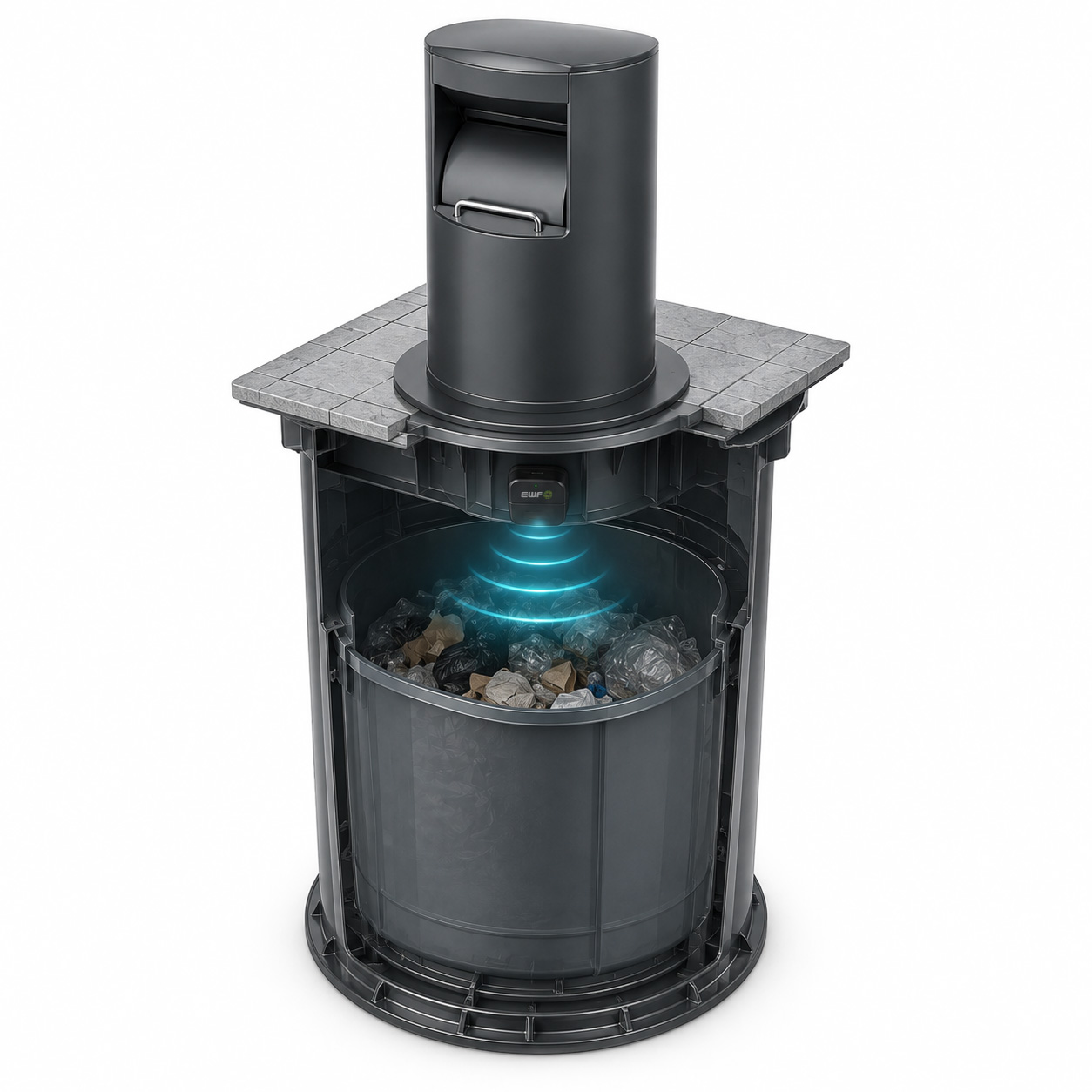
Illustration of level measurement in an underground tank. Installation and sensor selection are tailored to the tank.
Design, materials, location, and waste type all influence the choice of sensor and installation method.
Check coverage, reporting, and what information operations staff need to be able to view.
Determine who is responsible for monitoring the information, scheduling pickups, and verifying that the procedures are working properly.
Adapt to the location
Get an overview of the entrances and common areas.
Adjust the frequency of service based on peak times and passenger flow.
Track variations between weekdays, weekends, and seasons.
From Need to Successful Operation
Tell us what types of bins you have and how they are currently emptied. We’ll help you assess the conditions for a pilot program and choose what to monitor—such as emptying schedules, routes, and overflowing bins.
Questions and Answers
In many cases, but this must be evaluated for each solution. The vessel's design, material, contents, and location all affect both installation and measurement.
No. Standalone sensors can be used in several types of containers. Bigbelly also offers integrated sensors in its smart models. The choice depends on the container and what you want to achieve.
It depends on the sensor selected, the settings, and the connection. The measurement and reporting intervals need to be adjusted based on how quickly the tanks fill up and how the operation works.
They can provide a basis for reducing the number of unnecessary collections. The results depend on current procedures and how the information is used to adjust the schedule. Follow up on the results of a pilot program.
No. Start where the load is difficult to predict, the distances are long, or the problems recur. Use that experience to determine whether more vessels should be connected.
Let's work together!
Customer service: +46 (0)10-495 24 95
Head office: Vallbyvägen 22, 76251 Rimbo, Sweden
Mon-Fri: 07:30-16:30