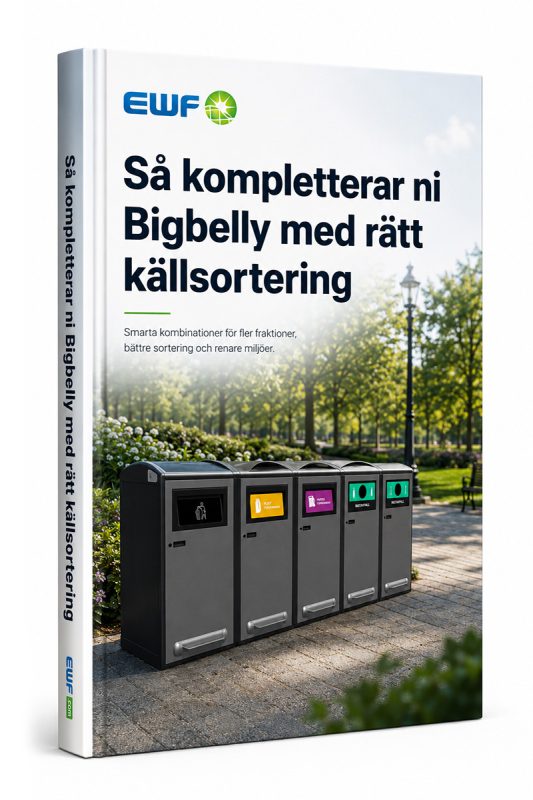
It all started with two smart waste stations in downtown Alingsås. Since then, the municipality has continued to develop the system—from standalone, connected stations to a larger network and modular solutions for source separation. Today, the initiative comprises about 50 Bigbelly units in public spaces.
What makes Alingsås most interesting, therefore, is not just the number of stations. It is the fact that the municipality has continued to expand the system over several years and adapted it as the city’s needs have changed.
Two stations served as the starting point
In the summer of 2018, the municipality of Alingsås installed its first two “ Bigbelly ” stations at Lilla Torget and Åmanska Parken.
The stations were solar-powered, compact, and connected. Sensors reported fill levels and notified the operations team when a station needed to be emptied. Since the stations were portable and equipped with GPS, the municipality could also track their usage and adjust their placement based on where the need was greatest.
This gave Alingsås the opportunity to test the technology in a real-world urban environment and gain experience before the system was expanded.
Those initial experiences led to more stations
By 2019, the municipality had already tripled the number to six. At that time, the stations were located at Lilla Torget, Åmanska Parken, Stora Torget, and along Kungsgatan.
The municipality reported that staff received notifications directly on their cell phones regarding the need for emptying, and that the stations were used more frequently than the previous trash cans. Based on this experience, Alingsås was already considering investing in more units at that time.
“We’ve been very satisfied with the trash cans we’ve had, and the people who empty them receive information directly on their cell phones.”
Åke Aronsson, then infrastructure project manager for the Municipality of Alingsås, 2019
Next step: from individual collection stations to source separation
The expansion has not merely involved installing more of the same type of units. The system has also evolved from standalone stations for a single waste category to modular stations where multiple categories can be collected in the same location.
Looking ahead to 2026, Alingsås Technical Services outlined a continued expansion involving 22 new “ Bigbelly ” bins. The new units would be placed alongside existing stations to enable the sorting of plastic packaging and residual waste in urban areas.
The expansion took place at the same time that the municipalities’ responsibility for collecting packaging waste in public squares, parks, and other popular locations was expanded, effective January 1, 2026.
Bigbelly-The platform’s modular design makes it possible to expand existing stations with additional waste streams and functions as needs change. This means that the municipality does not have to start from scratch when sorting requirements or capacity needs increase.
About 50 units in a growing system
Today, Alingsås has approximately 50 “ Bigbelly ” units in the urban environment. What began as a trial at two locations has thus become an established part of the municipality’s waste management in public spaces.
Different locations may require different solutions. Where a stand-alone station is sufficient, it can continue to be used, while locations with higher volumes or sorting needs can be equipped with more sorting bins and higher capacity.
The connected stations also provide the operations team with information on fill levels and the need for emptying. This creates better conditions for prioritizing actions based on actual demand rather than working solely according to fixed inspection routes.
A Case Study on Starting at the Right Scale
Alingsås demonstrates a practical path from testing to long-term establishment:
The municipality started with a few select locations, monitored how the stations functioned in everyday use, and then expanded the system accordingly. When new waste sorting needs arose, the existing system could be expanded rather than replaced.
This, therefore, is not just a case about more trash cans. It is a case about how a smart waste management system can expand geographically, functionally, and over time.
Would you like to improve your waste management step by step?
EWF helps municipalities analyze location, capacity, waste categories, and operational requirements—from an initial pilot installation to a larger smart waste management system.
Schedule a review of your municipal waste management system.