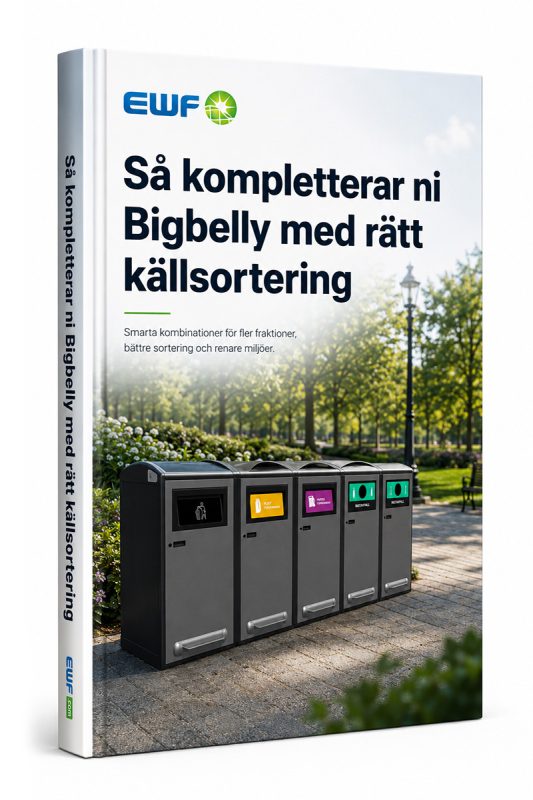
Welcome to our guide on effective recycling and the use of smart bins in public spaces. This article provides an in-depth understanding of how modern technology and thoughtful strategy can improve waste management and make our public spaces cleaner and more sustainable.
Waste separation in public outdoor areas
The importance of waste separation in public places
From January 1, 2026, source separation will be introduced in public places in Sweden. This is a continuation of the existing waste sorting behavior at home and at work. Making source separation available outdoors will proactively reduce littering and reinforce environmentally friendly behavior.
Waste separation in public places is key to achieving high recycling targets
One of the main challenges is a lack of awareness and nonchalance from the public. Many people avoid recycling correctly due to ignorance or lack of motivation. Education campaigns and clear labeling are therefore critical aspects.
Design and type of waste separation bins for public use

Modular systems
Choosing the right type of recycling bins is essential to maximize efficiency. Modular systems offer flexibility and can be adapted to specific needs and locations, making them an ideal solution for many public spaces.
The design of recycling bins can also play a major role in how efficiently waste is handled. Innovative solutions that are user-friendly and aesthetically pleasing increase the chances of them being used correctly.
Read more about our models here.
Implementation of sorting stations in public environments
Planning and strategies
Careful planning is necessary to ensure that sorting stations are effective. This includes location, number of recycling bins and accessibility. By analyzing case studies where sorting stations have been successfully implemented, we can learn lessons and apply best practices to new projects.
Uniform signage for waste sorting from Avfall Sverige.

One of the most effective ways to increase participation in recycling in public spaces is through the use of uniform signage. The Nordic region has long been a pioneer in environmental awareness and sustainable development, and a common initiative has been to standardize waste sorting signage across the region. This approach not only simplifies the process for the public but also contributes to more consistent and efficient recycling.
Read more about joint signage for waste sorting here.
Technical solutions and innovations we offer
Sensors and IoT in source separation systems
The integration of the Internet of Things (IoT) and sensors in source separation systems can dramatically improve waste collection and management. Sensors can monitor the fill rate and composition of waste in real time, facilitating more dynamic and responsive management.
Data collected from smart bins and recycling systems can be used to further optimize waste management. This data can be analyzed to identify patterns in waste generation and recycling efficiency.
Behavioral aspects of waste sorting.

Ekerö municipality has recently installed more Bigbelly bins with different sorting options to promote recycling in the public environment. These units not only improve the appearance of public spaces such as Ekebyhov Castle, but also offer unparalleled efficiency with their 570-liter capacity and advanced compaction technology.
How to motivate people to recycle
Understanding the psychological drivers of recycling is key to designing effective campaigns and schemes. Using positive reinforcement, such as praise or rewards for correct sorting, can be very effective. Communication plays a crucial role in the success of recycling in public places. Clear, simple and directly appealing messages increase the likelihood that the public will engage in recycling.
Environmental and sustainability benefits
Contributing to sustainable cities
Through efficient source separation, we contribute to creating more sustainable cities. Less waste going to landfill and higher recycling rates reduce the city's carbon footprint and promote a sustainable urban environment.
Source separation plays a key role in reducing the amount of waste produced and increasing the amount of materials recycled. This is essential to reduce the environmental impact of waste production.
Conclusion
The implementation of smart waste bins and efficient recycling systems in public spaces is crucial to achieving environmental and social sustainability goals. By integrating technology, design and community engagement, we can create more sustainable and cleaner public spaces for future generations.