Keep track of fill levels and emptying with smart waste sensors
Many waste streams are difficult to plan for. Some bins fill up quickly, while others remain almost empty. The volume of waste can vary depending on location, weather, season, events, residential patterns, business activities, and visitor traffic.
Fill sensors provide better control over what’s actually happening. By measuring fill levels, you can see which containers need to be emptied, which ones are used the most, and where there’s a risk of containers becoming overfilled.
This makes waste management more precise, more efficient, and easier to monitor.
What are waste level sensors?
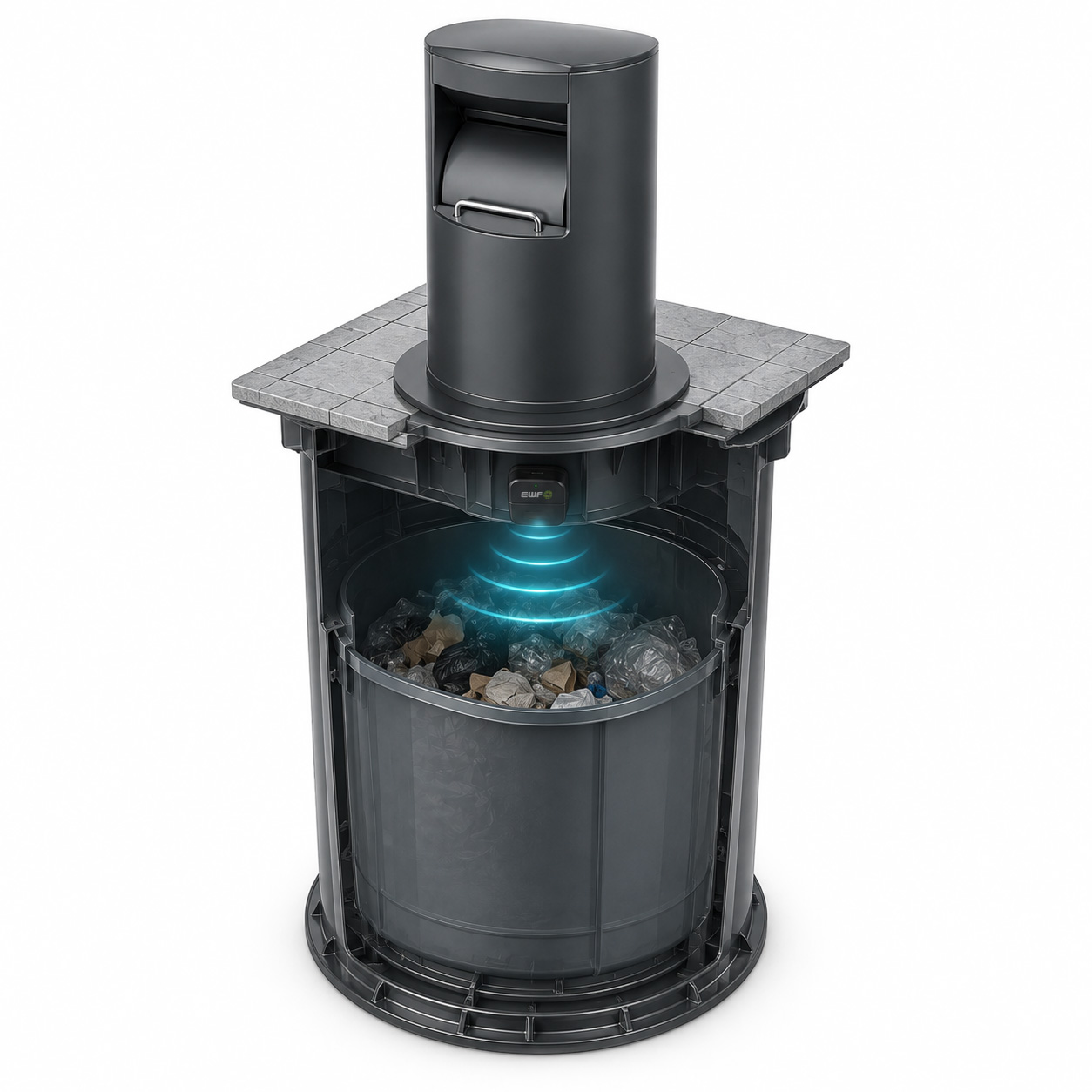
Fill-level sensors are sensors that measure how full trash cans, wastebaskets, or containers are. This information can then be used to schedule emptying, monitor usage, and understand how different locations are used over time.
The sensors can be used in many different types of waste management solutions, such as:
- trash cans in public spaces
- Waste bins in buildings
- recycling bins in parks and green spaces
- containers at the travel center and public transportation stops
- recycling stations in residential areas
- containers in town squares and city centers
- solutions for waste sorting
- smart trash cans from various suppliers
- existing vessels equipped with sensor technology
What matters isn't just the sensor itself. What matters is how the data is used to improve operations, placement, capacity, and emptying procedures.
That's why fill data is so valuable

Without data, waste management is easily guided by set routines, outdated assumptions, or urgent problems. This may work in some settings, but it often leads to unnecessary collections in some places and overflowing bins in others.
Filling level sensors provide you with a better basis for decision-making.
This may help you:
- see when the bins actually need to be emptied
- reduce unnecessary collection rounds
- avoid overflowing trash cans and bins
- reduce littering around trash cans
- prioritize the right locations during periods of high demand
- track which containers are used the most
- identify misplaced or underutilized containers
- plan capacity for the season, weekends, and events
- establish better communication with operations contractors
- make more accurate investment decisions
This is one of those solutions that may seem simple on the surface, but that makes a big difference in everyday life when used correctly.
How Level Sensors Work in Practice
A fill-level sensor is placed inside or on top of a bin, trash can, or container. The sensor measures the fill level and transmits the information to a digital system where you can monitor the status.
Depending on the solution, you might see, for example:
- current fill level
- which vessels are approaching full capacity
- which containers need to be emptied first
- History of Fill Level
- load over time
- alarms or notifications when the fill level is high
- patterns linked to place, time, and season
The data makes it easier to transition from reactive operations to planned and demand-driven emptying.
Instead of discovering the problem when the bin is already overflowing, you can take action before it becomes noticeable to visitors, residents, or customers.
Sensors for various types of vessels and suppliers
Fill sensors are not limited to a single product or supplier. They can be used in various types of waste management solutions depending on needs, the environment, and technical conditions.
EWF ECO solutions that allow sensors to be combined with various types of containers, systems, and suppliers.
For example, this could include:
- standalone sensors in existing vessels
- sensors in new trash cans
- sensors as part of smart trash cans
- sensors for waste collection stations
- Sensors in waste compaction solutions
- vendor-specific systems
- customized solutions for municipalities, real estate, and public spaces
Bigbelly an example of a smart waste management solution that integrates technology, capacity, and monitoring. However, fill sensors can also be useful in other systems and in conjunction with other providers.
Learn more about smart trash cans
When are level sensors sufficient?
In certain environments, fill sensors can be a very effective solution without having to replace the entire fleet of containers. This is especially true when you already have functional containers but lack control over fill levels and emptying needs.
Sensors may be sufficient when:
- The existing containers work well, but the emptying process needs to be optimized
- the problem is primarily a lack of an overall perspective
- You want to reduce unnecessary inspection rounds
- Some containers fill up unexpectedly quickly
- You want to test demand-based collection on a smaller scale
- You want to collect data before making major investments
- You need better oversight of the operations contractor or internal operations
Bin-level sensors can be a smart first step. They provide insights before you decide whether you need more bins, greater capacity, or smart trash cans.
When are smart trash cans needed instead?
In other settings, simply measuring the fill level is not enough. If the load is very high, the surface is sensitive, or emptying the bin is expensive and time-consuming, smart trash cans with higher capacity and compaction features may be a better choice.
Smart trash cans can be particularly useful when:
- Bins often become overfilled despite being emptied frequently
- The site has a high volume of visitors
- Emptying is complicated, expensive, or time-consuming
- There are problems with trash around the trash cans
- You want to reduce the number of in-person pickups
- You need higher capacity in a limited space
- This location is especially important to the visitor's experience
- You want to combine sensors, capacity, and monitoring into a more comprehensive solution
One does not preclude the other. Often, the best solution is a combination: sensors where existing bins are sufficient, and smart trash cans where the volume of waste is highest.
Reduce Unnecessary Emptying
One of the major advantages of level sensors is that they make the emptying process more accurate.
In many areas, bins are emptied according to fixed schedules. This can mean that staff or contractors make trips to bins that do not need to be emptied. At the same time, other bins may become full between collection rounds.
With supplementary data, you can better manage your efforts.
This can help:
- fewer unnecessary collection rounds
- less time spent on manual checks
- reduced transportation
- more efficient use of staff time
- fewer emergency responses
- better planning during periods of high demand
- more thorough monitoring of operating costs
It's not about making operations more complicated. On the contrary. The right data makes it easier to set priorities.
Avoid overfilling trash cans and littering
Overflowing bins quickly cause problems. When a trash can or container is full, trash often ends up spilling out onto the ground. From there, it can be spread further by the wind, birds, pests, or passersby.
With level sensors, you can receive alerts before the tank becomes overfilled.
It will help you:
- take action before the problem becomes apparent
- reduce litter around trash cans
- improve cleanliness in public spaces
- reduce complaints from residents, visitors, and businesses
- improve organization in high-traffic areas
- avoid emergency cleaning
This is particularly important in areas with high foot traffic, such as public squares, parks, shopping centers, transportation hubs, and buildings with common areas.
Better monitoring over time
Level sensors don't just provide information about the current status. They also generate historical data that makes it easier to understand patterns over time.
For example, you can follow:
- which containers fill up the fastest
- which locations have the highest traffic volume
- which days and times generate the most waste
- how the season and weather affect usage
- how events affect fill levels
- if a new placement works better
- whether certain vessels can be removed or moved
- if capacity needs to be increased in certain locations
This type of data is valuable for operations, planning, and investments. Instead of guessing, you’ll have a better basis for decision-making.
In what types of environments are level sensors suitable?

Level sensors can be used in many different environments where waste flow varies or where emptying needs to be more precise.
Examples of environments where sensors might be suitable:
- parks and green spaces
- squares and city centers
- travel centers and public transportation hubs
- properties and residential areas
- retail areas and shopping centers
- schools and campus areas
- hospital campuses
- workplaces
- areas with a high concentration of tourists
- swimming areas and recreational areas
- mobility hubs
- public walkways
- event spaces
- garbage rooms and communal recycling stations
The more uneven the load is, the greater the value the sensor data can provide.
Fill Level Sensors for Municipalities
Municipalities often have many trash cans scattered across large areas. Parks, squares, swimming areas, walkways, bus stops, and central locations may all have different collection needs.
Level sensors can help municipalities:
- get a better overview of many places
- reduce the number of overflowing trash cans in public areas
- optimize collection routes
- reduce unnecessary transportation
- plan better for seasonal peaks
- monitor service contractors
- gain a better basis for purchasing and placing containers
This makes it easier to keep public spaces clean without wasting resources where they aren't needed.
Fill Level Sensors for Property Owners
Property owners, housing companies, and retail spaces often need to manage waste in shared areas where many different users share the same spaces.
Level sensors can help property owners:
- reduce problems with overflowing bins
- gain better control over waste rooms and common areas
- reduce complaints from residents, tenants, and visitors
- improve waste disposal procedures
- improve communication with service providers
- See which locations need more capacity
- create cleaner and better-maintained environments
This is particularly valuable in properties where waste volumes vary significantly between weekdays, weekends, and seasons.
Occupancy Sensors for High-Traffic Public Spaces
In areas with large numbers of people and short visit durations, waste can accumulate quickly. This applies, for example, to travel centers, train stations, city centers, shopping areas, and event venues.
Level sensors can help you:
- See which vessels are under the most strain
- Prioritize emptying trash cans where the most people pass by
- reduce visible litter
- adjust operations to accommodate peak times, weekends, and events
- avoid making important spaces feel cluttered
- create a better experience for visitors and users
When traffic is heavy, cleanliness becomes especially important. An overflowing trash can in the wrong place can quickly ruin the entire impression.
Sensors or smart trash cans—which is the best option?
It depends on the environment, the load, and what you want to achieve.
Level sensors are often the best choice when:
- You have existing containers that work
- You need better control over fill levels
- you want to reduce unnecessary trips to the trash
- You want to try on-demand trash collection
- You want to collect data in preparation for major decisions
Smart trash cans are often the best choice when:
- the load is high
- containers often become overfilled
- You need more capacity
- emptying is expensive or difficult
- the location is particularly visible or sensitive
- You want to combine sensors, capacity, and operational monitoring
In many cases, the answer isn't one or the other. An effective solution can combine sensors, smart trash cans, and traditional bins in different locations.
Learn more about smart waste management
What is a waste fill sensor?
A waste level sensor is a sensor that measures how full a bin, trash can, or container is. This information can be used to schedule emptying, prevent bins from becoming overfilled, and track waste flows over time.
Do fill sensors only work with Bigbelly?
No. Fill-level sensors can be used in various types of bins, containers, and smart waste management solutions. Bigbelly an example of an integrated smart waste management solution, but sensors can also be used with other providers and in other types of systems.
Can sensors be installed in existing trash cans?
In many cases, sensors can be used to supplement existing vessels, but this depends on the vessel’s design, location, material, and environment. Therefore, the solution should always be evaluated based on the specific location.
How do sensors help reduce the number of times the tank needs to be emptied?
The sensors indicate which bins actually need to be emptied. This makes it possible to reduce unnecessary emptying of half-full bins and prioritize those that are close to being full.
Can fill-level sensors reduce littering?
Yes, they can help reduce littering by providing better control over when bins are at risk of becoming overfilled. When bins are emptied on time, the risk of waste ending up next to them is reduced.
In what types of environments are level sensors suitable?
Waste level sensors can be used in parks, public squares, city centers, buildings, transportation hubs, shopping centers, schools, campuses, residential areas, and other environments where waste volume varies or where emptying needs to be more precise.
Do all containers need to have sensors?
No. It’s often best to start with selected bins or locations where the problems are most severe. These might be bins that frequently become overfilled, locations with high traffic, or areas where emptying the bins is expensive or difficult to schedule.
What is the difference between fill sensors and smart trash cans?
Fill sensors measure fill levels and provide data on when emptying is needed. Smart trash cans can often combine sensors with higher capacity, compaction, and other features. The best solution depends on your needs.
Can sensor data be used to plan the placement of containers?
Yes. By monitoring fill levels over time, you can see which containers are used the most, which are used the least, and where capacity needs to be adjusted. This provides a better basis for placement and sizing.
How do you get started?
Start by identifying which locations have the biggest problems or the highest levels of uncertainty. Then, you can test sensors on selected bins, monitor the data, and adjust emptying routines or bin placement based on the results.
Tell us a little about your environment, your needs, and what you’d like to improve. We’ll help you find a solution that works for the location, the users, and your operations—without making things more complicated than they need to be.