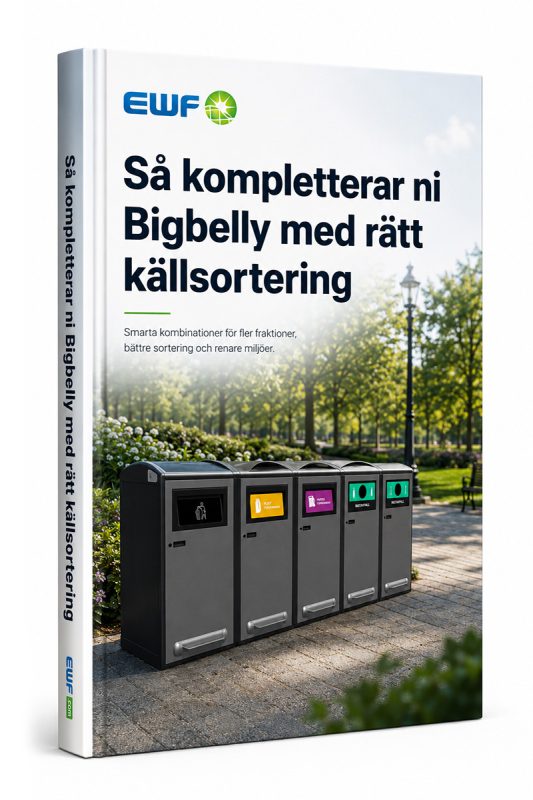
In January 2026, a new law was introduced that means it should be possible to sort waste such as plastic and paper in public environments and public places.
It is the responsibility of municipalities to provide opportunities for waste sorting where people move around, spend time, and dispose of waste, for example in parks, squares, and areas larger than 2,000 square meters.
Since the new requirements came into effect, we have had many discussions with businesses and municipalities around the country about how sorting points can be planned, located, and function in practice.
The conversations have provided us with valuable insights into recurring issues, solutions being tested, and lessons that may be worth sharing.
This article is based on interviews about waste sorting with street engineers and waste management officials in Swedish municipalities that are actively involved in waste sorting and the collection of packaging waste in public areas.
Their experiences show that this is not a one-off effort, but rather a long-term and methodical approach that involves placement, behavior, operation, and follow-up.

1. Where, when, and how does waste occur?
The new legal requirement applies to places where significant amounts of waste are generated, often places where people move around, eat, or linger for a while, such as squares, parks, bathing areas, playgrounds, and bus stations.
To keep track of exactly where waste is generated and where waste sorting is needed, there are several possible approaches:
- litter measurements
- Test temporary sorting stations for a period of time to see how they are used.
- tools for analyzing fill rates and usage over time.
We see that many municipalities are experimenting and view placement as an ongoing process.
Waste stations are moved between different locations, fractions are evaluated, and placement is adjusted for periods when pressure on a location increases, especially before peak seasons. A park or bathing area may have completely different amounts of waste in July than in February.
Identifying where waste is generated involves understanding when, how, and why waste is generated and using that knowledge to determine where sorting points are most useful.
Would you like to know more about how waste stations can contribute to better waste sorting?
Read our article on smart waste sorting in public environments
2. Which fractions are needed?
Different locations generate different types of waste. At a bathing spot, beverage containers and ice cream wrappers often dominate. At a commuter hub, it may be more a case of takeaway packaging.
In parks where people spend longer periods of time, there is often a greater variety of waste.
Many municipalities choose to include residual waste as well, even though this is not a legal requirement. This reduces the risk of litter ending up on the ground or in the wrong bins.
The fractions available are:
- plastic packaging
- metal
- paper packaging
- tinted glass
- clear glass
When the right fractions are in the right place, the chances of the material actually being sorted and recycled increase.
If you would like to read more about waste sorting, please read Waste sorting in parks – it should be easy to do it right.
3. Assessment support for placement
One of the most common questions we receive is where the sorting stations should be located.
A really good tip for successful waste sorting in public environments came from a waste management manager who explained how they had developed an assessment tool to help local authorities determine what type of sorting point is needed in different locations.
The administration began work on reviewing the placement of multi-fraction containers in the city center and analyzing how different locations are used in practice.
The next step was to develop a common assessment model to support park managers and others who work with public environments. The idea is to create a more systematic way of determining what type of sorting point is suitable for different locations.
The assessment support takes into account, among other things:
- type of park, e.g., city park, playground, or nature area
- visitor flows
- typical amounts of waste
- Nearby amenities such as restaurants or activities Umeå Municipality
The aim is to create a more fact-based and uniform working method. Cleaning in public environments is a living system that changes as the city develops. The addition of a new playground or recreational area can be enough to suddenly change visitor patterns in an area. Umeå Municipality
Working with a common assessment tool makes it easier to create a more consistent standard throughout the municipality, so that residents know where they can expect to sort their waste.
4. How do you make operations, logistics, and follow-up work?
Once sorting stations are in place, the entire system needs to function on a daily basis.
In municipalities that already use multi-compartment containers, collection is often integrated into regular operations.
A typical workflow looks like this:
- residents sort waste directly at the station
- operating personnel collect the waste
- the material is transported to a collection point
- the fractions are collected in containers
- the material is weighed and reported
By weighing the material, the municipality can monitor how different waste fractions develop over time.
It also makes it possible to take a more data-driven approach to waste management and adjust locations, capacity, and emptying intervals.

5. How can we make it easy to sort waste correctly?
Ultimately, whether the system works depends on residents' behavior. The design of sorting stations therefore plays an important role. The stations need to be:
- clear
- easily accessible
- intuitive to use
Several municipalities are actively working with nudging, where design and communication are used to make it easier to do the right thing.
One example is Strängnäs Municipality, which creates engaging meeting places where trash cans are used as a tool to raise awareness of sustainability issues.
Among other things, the municipality has involved preschools in design projects to create a relationship with the trash cans and make them more visible in the urban environment.
Creative communication can also play an important role. Some cities use campaigns, partnerships with associations, and various activities to raise awareness about littering and engage residents.
In Randers, Denmark, trash cans are used to highlight the city's history and culture, a way to create pride in the public environment while influencing behavior.
When waste stations are clear, visible, and easy to understand, residents are more likely to use them correctly.
Conclusion
Waste sorting in public environments is a task that develops over time. Municipalities that have come a long way describe the process as iterative, where locations are tested, data is monitored, and solutions are adjusted in line with how the urban environment is used.
When household waste collection becomes standard in Sweden from 2027, expectations for sorting in urban areas will also increase. That is why many municipalities are choosing to start testing and building the infrastructure today.