A practical guide for municipalities and public facilities looking to establish the right waste sorting categories, the right capacity, and smarter operations
Many municipalities and public spaces have already made the switch to smarter waste management with Bigbelly. This has resulted in increased capacity, fewer overflowing bins, and more demand-driven operations.
But in many places, the next big opportunity remains: to supplement existing Bigbelly with recycling bins.
When residual waste, returnable containers, plastic, paper, and glass are clearly sorted into the right bins, it becomes easier for people to dispose of them properly. At the same time, waste collection points can be developed into a more comprehensive, modern, and sustainable solution for parks, town squares, transit centers, beaches, and other public spaces.
Not all groups need the same solution
A common misconception is that every faction needs the same type of station. That is not always the case.
In some locations, there is a high demand for capacity, compaction, and connectivity. This can be the case, for example, with general waste in high-traffic areas where trash cans fill up quickly. Bigbelly Max is often the best fit for such situations.
In other locations, the need may instead be to supplement an existing station with clearly labeled bins for, for example, returnable bottles, plastic packaging, paper packaging, or glass. In such cases, Bigbelly or Bigbelly may be a more suitable choice.
The important thing, then, is not to choose the “best” solution—but rather the right combination in the right place.
Build on what you already have
For customers who already have Bigbelly , the path to recycling Bigbelly often shorter than you might think.
Existing locations are already known. The operations team has experience with the solution. Waste streams are often easier to understand because of the practical experience gained on-site.
This makes it possible to build on it step by step:
Smart Max for locations with high waste volumes.
Smart, where connectivity and status data are needed.
Element, where a robust supplementary fraction is sufficient.
In this way, an existing Bigbelly can be expanded from a single waste collection point into a complete recycling station.
That's why we've put together a guide
To make your choice easier, EWF has developed a product selection guide for Bigbelly. The guide helps you understand the differences between Smart Max, Smart, and Element—and shows how the models can be combined to create smart waste sorting in public spaces.
In this guide, you'll find support with, among other things:
- which model is suitable for different types of locations
- when compression and high capacity are most important
- when an internet connection and data are needed
- when a simpler supplementary unit is sufficient
- how different models can be combined in the same station
- How to think about waste categories such as residual waste, returnable containers, paper, plastic, and glass
The goal is to make it easier to move from an idea to a concrete decision.
The right solution starts with the right questions
The choice of Bigbelly should always be based on the site’s needs. Therefore, it’s not just about the product model, but also about the current situation, operations, goals, and sorting needs.
Some important questions are:
- Which locations have the largest waste streams?
- Where do varicose veins occur?
- Which fractions are in demand?
- Is data and fill level monitoring necessary?
- What are the current disposal procedures?
- Are there seasonal variations or events that affect the workload?
Once these questions are answered, it will be much easier to choose the right combination of Smart Max, Smart, and Element.
From a guide to a concrete proposal
The guide is a first step. The next step is to take a look at your actual locations.
EWF is happy to assist with a needs analysis in which we review existing Bigbelly, waste streams, waste categories, operational conditions, and goals. The result is a clearer basis for decision-making regarding the right model, the right number of stations, the right locations, and the right service plan.
It doesn't have to be complicated. Often, it's just a matter of starting where the need is greatest—and then building on that step by step.
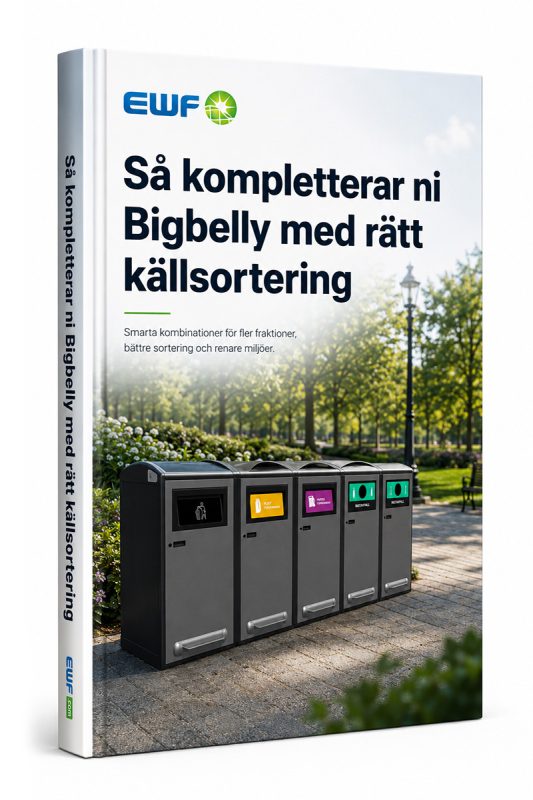
Download the guide
Would you like to add recycling bins to your existing Bigbelly?
Download the guide: How to Use Bigbelly Proper Waste Sorting:
Would you like help determining which locations should be prioritized first? Contact EWF, and we’ll develop a concrete proposal.